9 min read
Where to Find a Car's VIN Number: Every Location Explained
By Carfax Vin Check team · Automative Writer
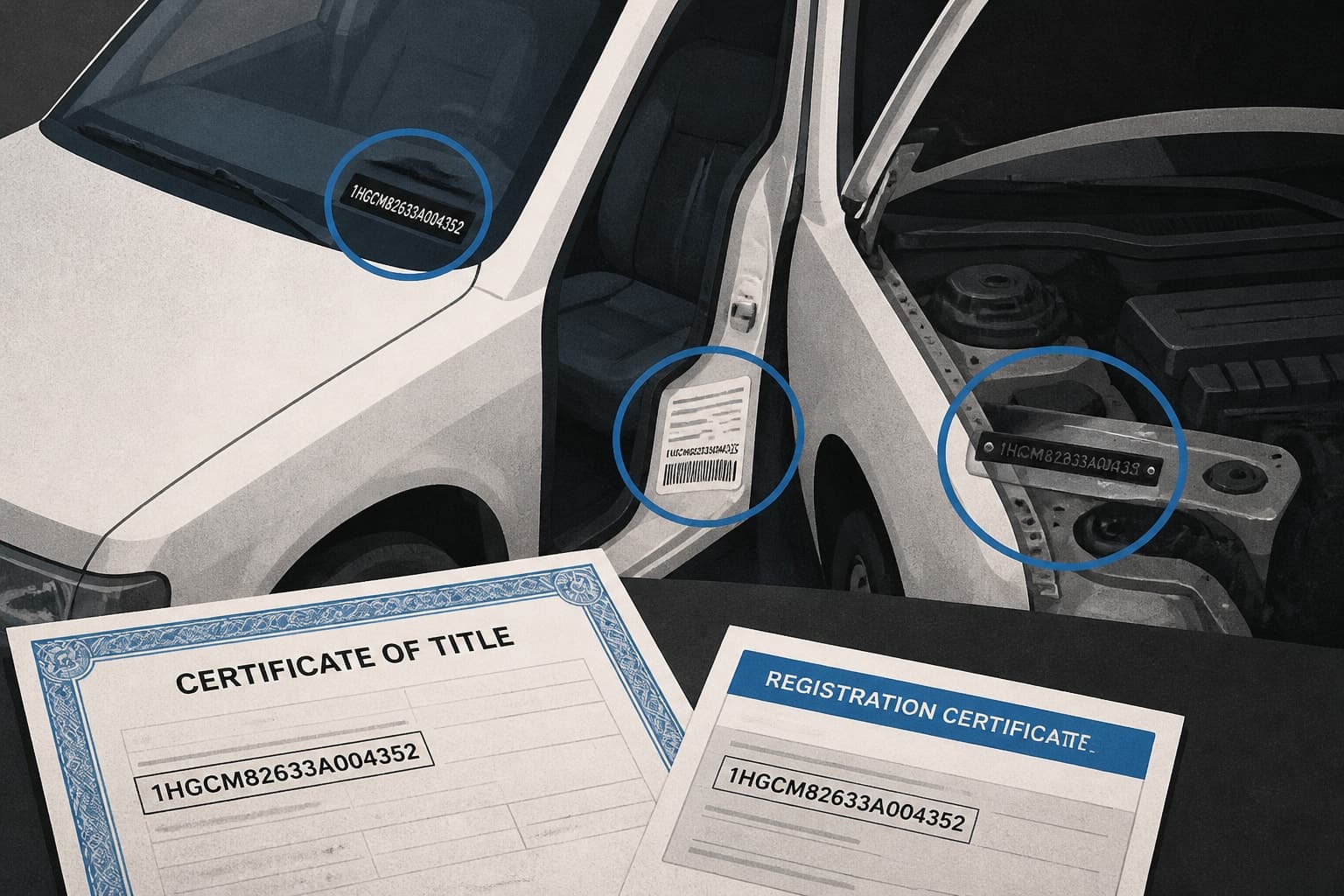
The fastest way to find a VIN number for a car is to look at the driver-side corner of the dashboard, where it meets the windshield, then check the sticker on the driver's door jamb. Both show the same 17-character code. If you can't get to the car, the title, registration and insurance card list it too.
That code matters most when you are about to pay for a used car. Every Carfax report is pulled by VIN, so you need the right one before you spend anything. This article covers every place to look, how to read what you find, and how to confirm the number is real.
Where is the VIN on a car?
The VIN sits in several fixed spots on most vehicles, and the two easiest are the dashboard and the driver's door jamb. The Texas Department of Motor Vehicles lists the dashboard and the driver's door or door jamb as places to look.
Start with these two, in this order:
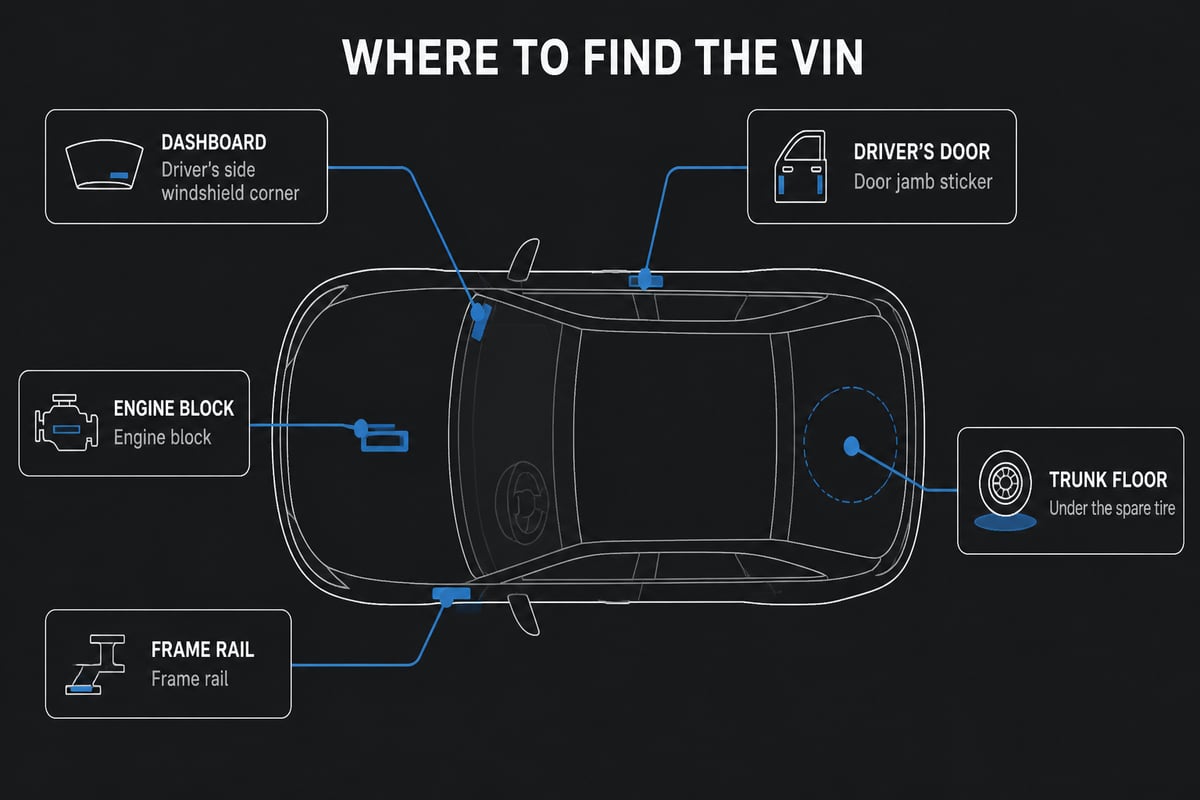
Dashboard, driver's side. Stand outside the car and look through the windshield at the lower left corner. You will see a small metal plate with the 17 characters stamped or printed on it.
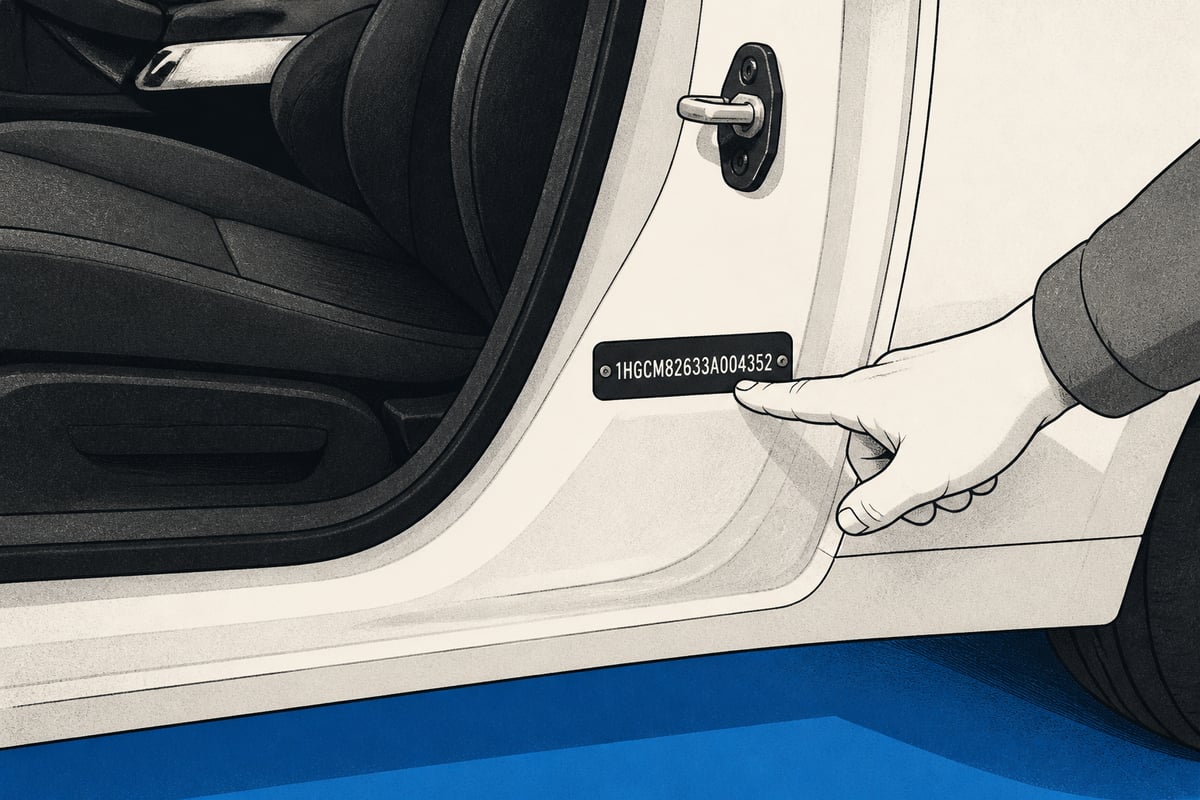
Driver's door jamb. Open the door and look at the edge of the door frame, or the door itself. A sticker there shows the VIN along with the build date, tire pressures and weight ratings.
If both match, you are done. If you can't find either, use the next section.
Other places to look on the vehicle
When the dashboard plate or door sticker is missing, damaged or unreadable, the VIN is also stamped in several less obvious places on the vehicle. Allstate's VIN guide covers common spots inside and outside the car.
Try these, roughly in order of how easy they are to reach:
Under the hood. Many cars have the VIN stamped on the engine block or on the firewall, the wall between the engine bay and the cabin.
Front of the frame. Trucks and some SUVs have it stamped on the frame rail near the front wheel.
Trunk. Look under the spare tire cover or on the trunk floor. Some manufacturers stamp it there.
Inside the wheel well. Less common, but a few makes put a stamp or sticker here.
Under the seat or carpet. Some vehicles have a stamped number on the floor pan beneath the driver's seat.
Other body panels. Many manufacturers also put small labels with the VIN on the fenders, doors or hood.
Bring a flashlight. Stamped numbers collect dirt and can be hard to read at an angles.
How to find a VIN number for a car you can't see in person
You can find the VIN for a car that isn't in front of you by asking the seller for it or by reading it off paperwork the owner already has. This is the situation most online shoppers are in.
Documents that list the VIN include:
Vehicle title
Registration card
Insurance card or policy declarations page
Service and repair invoices
Original bill of sale or purchase contract
Recall notices from the manufacturer
If you are shopping online, the listing often includes the VIN. If it doesn't, ask the seller for it. A private seller with nothing to hide will send it in a text. A seller who dodges the question is telling you something.
One practical tip for comparing several cars: ask each seller for a photo of the dashboard plate and a photo of the door jamb sticker, not just a typed number. Typos are common, and two photos let you confirm both locations agree before you run a report.
Why a license plate won't do the job
A license plate is not a VIN, and most tools that produce a vehicle history report need the VIN itself. Plates get transferred, swapped and reissued, so they don't identify a vehicle the way a VIN does.
If all you have is a plate number, ask the seller for the VIN. If you are the owner, check your title or registration. Carfax Vin Check works from the VIN only, so it isn't the right fit if a plate is all you have.
How to read the 17 characters
A VIN is 17 characters of letters and numbers, and each block tells you something specific about the vehicle. The letters I, O and Q are never used, so they can't be confused with 1 and 0.
Position What it tells you 1 to 3 Country of manufacture and the maker 4 to 8 Model, body style, engine and other vehicle details 9 Check digit, used to catch fake or mistyped VINs 10 Model year 11 Assembly plant 12 to 17 Production sequence number
The tenth character is handy. It is a letter or number code for the model year, so you can compare it to the year in the ad in a few seconds.
For deeper reference, the National Insurance Crime Bureau publishes an annual passenger vehicle identification manual covering VIN structure and decoding for most U.S. and Canadian passenger vehicles, light-duty trucks, motorcycles, ATVs and some snowmobiles. Its commercial manual covers trucks and trailers from the previous four model years. You don't need either to shop for a used car, but they show how standardized the system is.
Check that the VIN matches the car
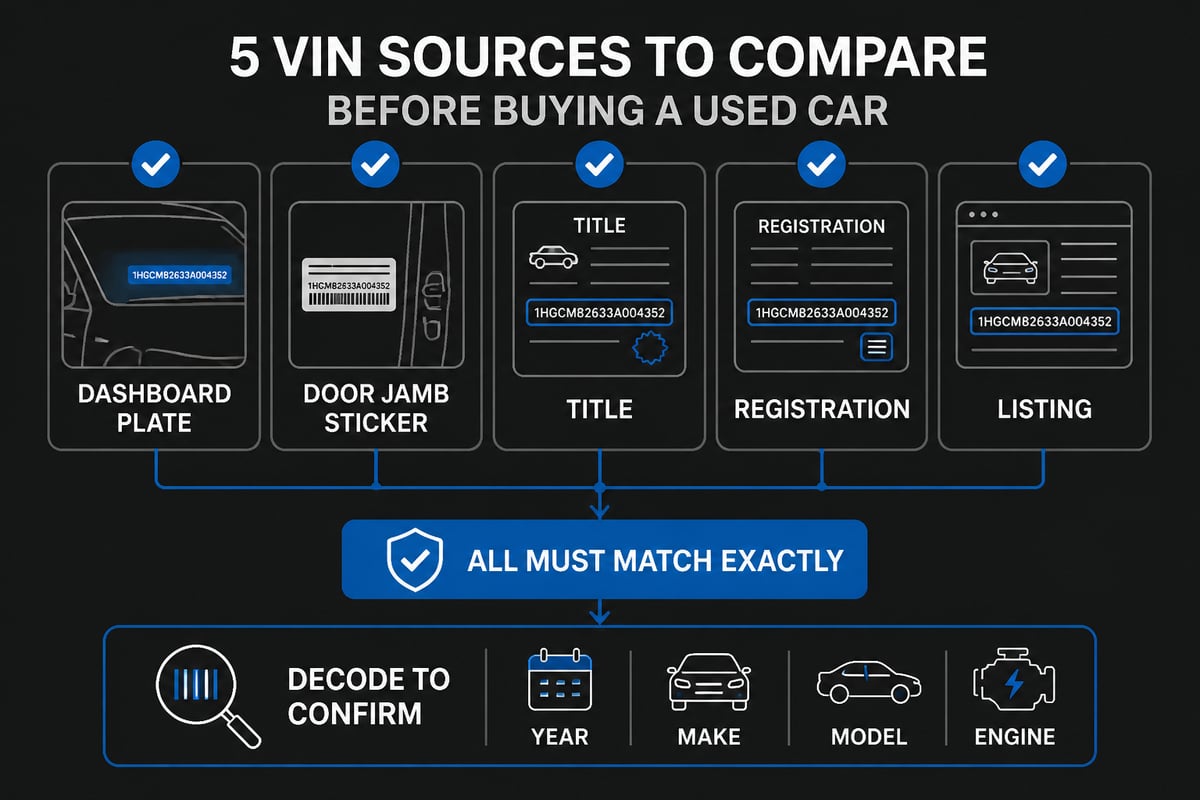
Confirming that the VIN on the car matches the VIN on the paperwork is the most important check you can do before buying, and it takes about two minutes. A mismatch can mean a clerical error, a replaced body panel, or something much worse.
Compare these against each other:
Dashboard plate
Door jamb sticker
Title
Registration
The VIN in the listing
All five should be identical. If one is off by a single character, don't hand over money until you know why.
Next, decode the VIN and see whether the year, make, model and engine match what the seller told you. The free VIN decoder from Carfax Vin Check uses NHTSA data and needs no account, so you can run it on your phone while standing next to the car. NHTSA keeps improving its own decoder; its release notes show version 3.59, released April 19, 2025, added sharing of individual full-VIN decode results by text or email, which is useful if you want to send a result to a friend or mechanic.
If the decoded details don't match the car, walk away or ask hard questions. For more on this step, see our guide on car identification by VIN and the VIN verification walkthrough.
Signs a VIN has been tampered with or cloned
A VIN that looks wrong, feels loose or doesn't match across locations is a warning sign, and you should stop and investigate. Tampering is rare, but it happens, especially with stolen or heavily damaged cars.
Watch for:
A dashboard plate with scratches, glue or crooked rivets. Factory plates are riveted cleanly and sit flat.
A door sticker that looks new, peeling or different in font. Original labels match the rest of the car's age.
Stamped numbers with uneven spacing or tool marks. Factory stamping is consistent.
Different VINs in different places. This is the clearest red flag.
Paperwork that doesn't match the plate. Even a small difference counts.
VIN cloning is when a thief copies a legitimate VIN onto a stolen car. The paperwork looks fine because it belongs to a real vehicle. Our write-up on the VIN cloning scam explains how it works and how to spot it.
You can also run the VIN through NICB's VINCheck, which can help show whether a vehicle has been reported as unrecovered stolen or salvage. It is a quick extra screen, not a replacement for a full history report.
What to do once you have the VIN
Once you have a confirmed VIN, you can check the car's history before you pay, and that is where the real savings happen. A clean-looking car can still have a salvage title, flood damage or a rolled-back odometer.
A Carfax report built from the VIN can show:
Accident and damage records
Title brands such as salvage or rebuilt
Number of owners and how long each kept the car
Odometer readings over time
Service history
Open recalls and other flagged items
Carfax Vin Check sells the full Carfax report, not a summary. You see the vehicle the VIN belongs to before you spend anything, which is a good last check that you typed the right number. Reports usually arrive in about a minute. US and Canadian VINs only.
Payment is a single purchase with nothing renewing and no subscription to cancel. Credits never expire, and unused credits are refundable within 30 days. If a report can't be produced, its credit comes back automatically. For current figures, see our pricing page or look at a sample report first.
If you are comparing several cars, the multi-credit setup is useful because you can run each VIN as you narrow your list.
Common mistakes when you find a VIN number for a car
The most common mistakes are misreading a character, copying the wrong number and trusting a VIN from only one source. Each one can send you to the wrong report or give you false confidence.
Mixing up similar characters. The letter S and number 5, or B and 8, look alike on worn plates. Since I, O and Q are never used, a character that looks like one of them is probably a 1 or 0.
Copying the VIN from an ad without checking the car. Sellers sometimes paste the wrong VIN from a similar listing.
Using the engine number or another stamp. Engines and transmissions have their own serial numbers. Only the 17-character code is the VIN.
Photographing the VIN at a glare angle. Take it in shade or with your phone flashlight so every character is legible.
Skipping the second location. Always confirm the VIN in at least two places on the car.
If you get a "VIN not found" or a decode result that doesn't fit the car, re-check each character before assuming anything is wrong with the vehicle.
Frequently asked questions
Is the VIN the same as the serial number?
On modern cars, yes. The VIN is the vehicle's serial number. Older vehicles from before 1981 used shorter, non-standard numbers, so a pre-1981 classic may not have a 17-character code.
Can I find the VIN on my phone without being near the car?
You can, if you have old paperwork. Check your insurance app, your registration, or an email from a past service visit. Many insurers show the VIN on the digital ID card.
Are VINs unique?
Every vehicle built since 1981 has its own VIN, and no two should be the same. That uniqueness is why a history report can follow one car across owners and states.
Is the VIN on the title or the car more reliable?
Neither alone. Treat the car as the source of truth and the title as the record, and make sure they match. A difference between them is exactly the kind of thing worth resolving before you buy.
Is it safe to share a VIN with a seller or a report service?
Yes. A VIN identifies a vehicle, not you. It is printed on the windshield for anyone to see, and it is used for recalls, registrations and history lookups every day.
Take your phone out to the car and photograph the dashboard plate and the door jamb sticker, then compare them to the title and the listing. If you want to confirm the car matches its description first, run the number through the free VIN decoder. Then pull the full history so you know about accidents, title brands and odometer readings before you hand over any money, and Carfax Vin Check lets you get the report for each car on your shortlist.
Check the car before you buy it
The full Carfax report for $7.99, or $3.70 each in a 20-pack.