VIN Checks5 min read
VIN cloning: how the scam works and how to spot it
By Carfax Vin Check team
VIN cloning is when a stolen car is given the identity of a legal one. Thieves copy the VIN from a similar car, usually the same make, model and color, put it on fake plates and stickers, and sell the stolen car with forged or borrowed paperwork. Every check you run on that VIN comes back looking fine, because it belongs to a real car that isn't stolen. The trick is to stop checking only the number and start checking whether the number belongs to the car in front of you.
VIN cloning at a glance
- What it is: a stolen car wearing the VIN of a legal "twin".
- Why it works: the VIN passes every database check, because the twin is real.
- Who loses: the buyer. Police can take a stolen car back, and the money usually goes with the seller.
- How to catch it: match the VIN in every place it appears, match the car to what the VIN says it should be, and match the paperwork to the seller.
How the scam works
A thief steals a car, then finds a legally registered car of the same model, often by walking a parking lot or browsing listings, and copies its VIN. New VIN plates and door stickers are made with that number, sometimes along with a forged title or a title obtained in another state. The stolen car is then listed at an attractive price, usually in a private sale where nobody asks many questions.
Because the VIN is genuine, it decodes to the right make and model, passes a check-digit test, and shows a normal history. That's what makes cloning harder to catch than a made-up VIN.
Where to find the VIN on a car
- On a plate at the base of the windshield, on the driver's side, readable from outside.
- On a sticker on the driver's door frame, usually with the build date and tire information.
- On the title, the registration and the insurance card.
- On many cars, stamped on the frame or engine bay and printed on labels on body panels. A mechanic can find these.
How to spot a cloned VIN, step by step
- Read the VIN on the dashboard plate and on the door sticker, and check they're identical, character by character.
- Look closely at the dashboard plate. Scratches, glue, uneven rivets or a plate that sits crooked are warning signs. So is a door sticker that's missing, damaged, or looks newer than the paint around it.
- Compare those numbers with the title and registration. All of them must match.
- Run the VIN through our free VIN decoder. It shows what the car left the factory as: year, make, model, body style and engine. If the car you're looking at has a different engine or body, the VIN isn't its own.
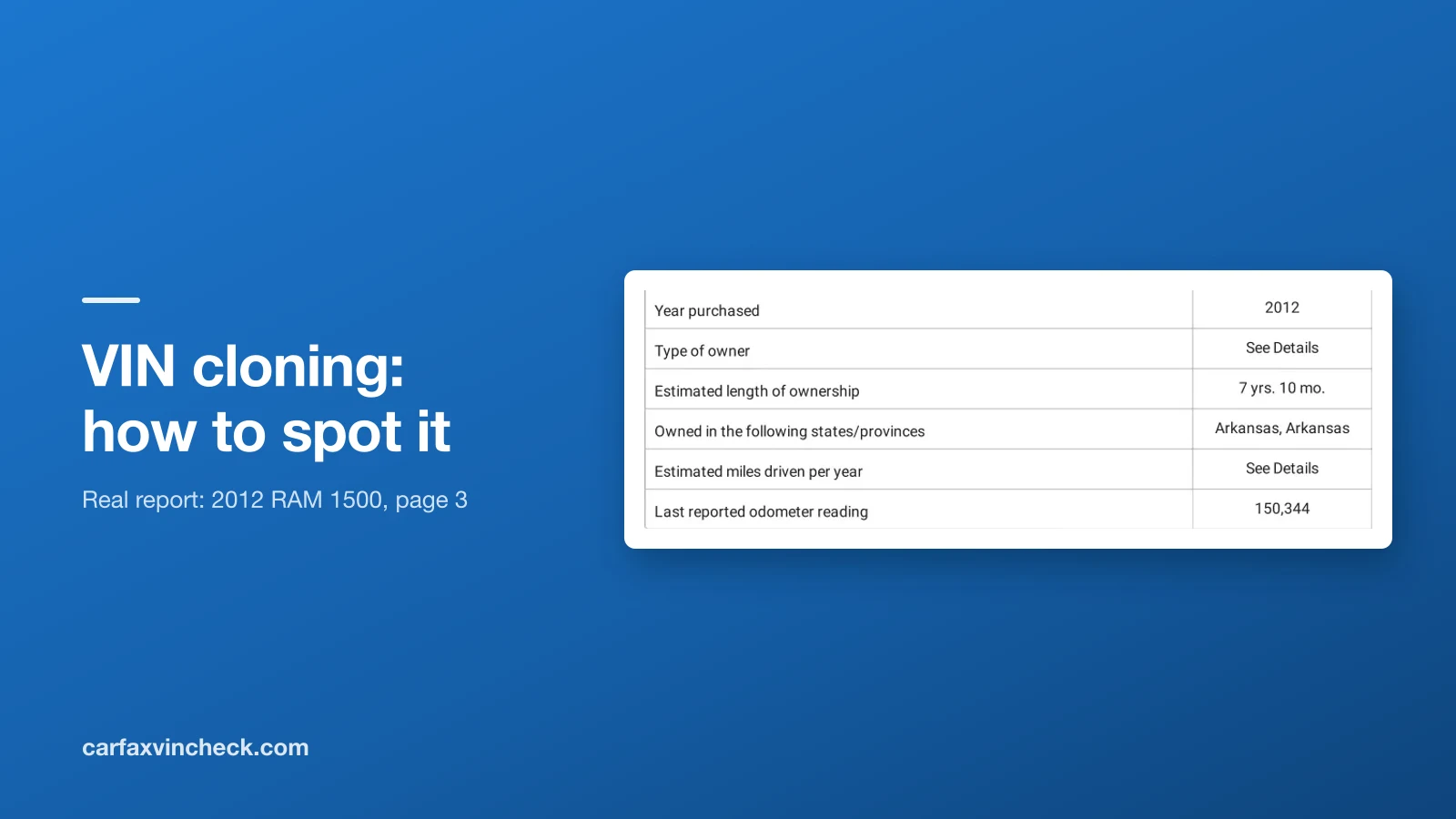
- Check the color and details in the history report. Registration records often note the color. In our sample report, a 2012 RAM 1500, the Arkansas registrations say "Vehicle color noted as Black", and the report lists the 5.7L V8 and extended cab. A white truck with a smaller engine and that VIN would be a problem.
- Read the history for places and dates. A cloned VIN's history belongs to the twin, so it may show registrations, services or inspections in a state the seller says the car has never been, or during a period the seller says they owned it.
- Run the VIN through NICB VINCheck, a free lookup that shows whether participating insurers reported the car stolen and not recovered. A clone of a non-stolen twin will come back clean, which is why the earlier steps matter more.
- Check the seller. The name on the title should match their ID, and the address should make sense. Ask how long they've owned the car and compare that with the history.
What a VIN validator can and can't tell you
The ninth character of a VIN is a check digit, calculated from the others. Our VIN validator tests it, which catches typos and invented numbers. A cloned VIN is a real one, though, so it passes. Treat a failed check as a red flag and a passed one as only the first step.
Red flags in the sale itself
- A price well below similar cars, with a reason that's hard to verify.
- Pressure to pay quickly, in cash, somewhere other than the seller's home.
- No spare key, no service records, and a title that was issued very recently.
- The seller won't let a mechanic look at the car, or won't meet at a police station's safe-trade spot.
If you suspect a cloned car
Don't buy it, and don't confront the seller. Note the listing, the VIN and the seller's details, and report it to your local police. If you've already bought a car and find the VINs don't match, contact the police and your insurer straight away. The national title database, NMVTIS, also lists approved title-history providers if you need a second record to compare.
Questions about VIN cloning
Can a Carfax report detect VIN cloning?
Not by itself, because the report describes the legal car the VIN belongs to. It helps you catch a clone when its details, like color, engine, states and dates, don't match the car or the seller's story.
What happens if I buy a cloned car?
Once the car is identified as stolen, it can be taken back and returned to its owner or their insurer. Getting your money back depends on recovering it from the seller, which is often hard.
How do I check that the VIN belongs to the car?
Match the VIN on the dashboard, door frame and paperwork, then compare the car with what the VIN decodes to and with the details in its history report.
Are cloned cars common?
They're much rarer than ordinary problems like accidents or title brands, but each one costs the buyer the whole price, so the checks above are worth the ten minutes.
Check whether a car's history fits the car. Enter the VIN for the full Carfax report, $7.99 for one or $3.50 a report in the 20-pack.
Check the car before you buy it
The full Carfax report for $7.99, or $3.50 each in a 20-pack.