Buying Guides10 min read
Car Identification by VIN: Complete Guide (2026)
By Carfax Vin Check team · Automative Writer
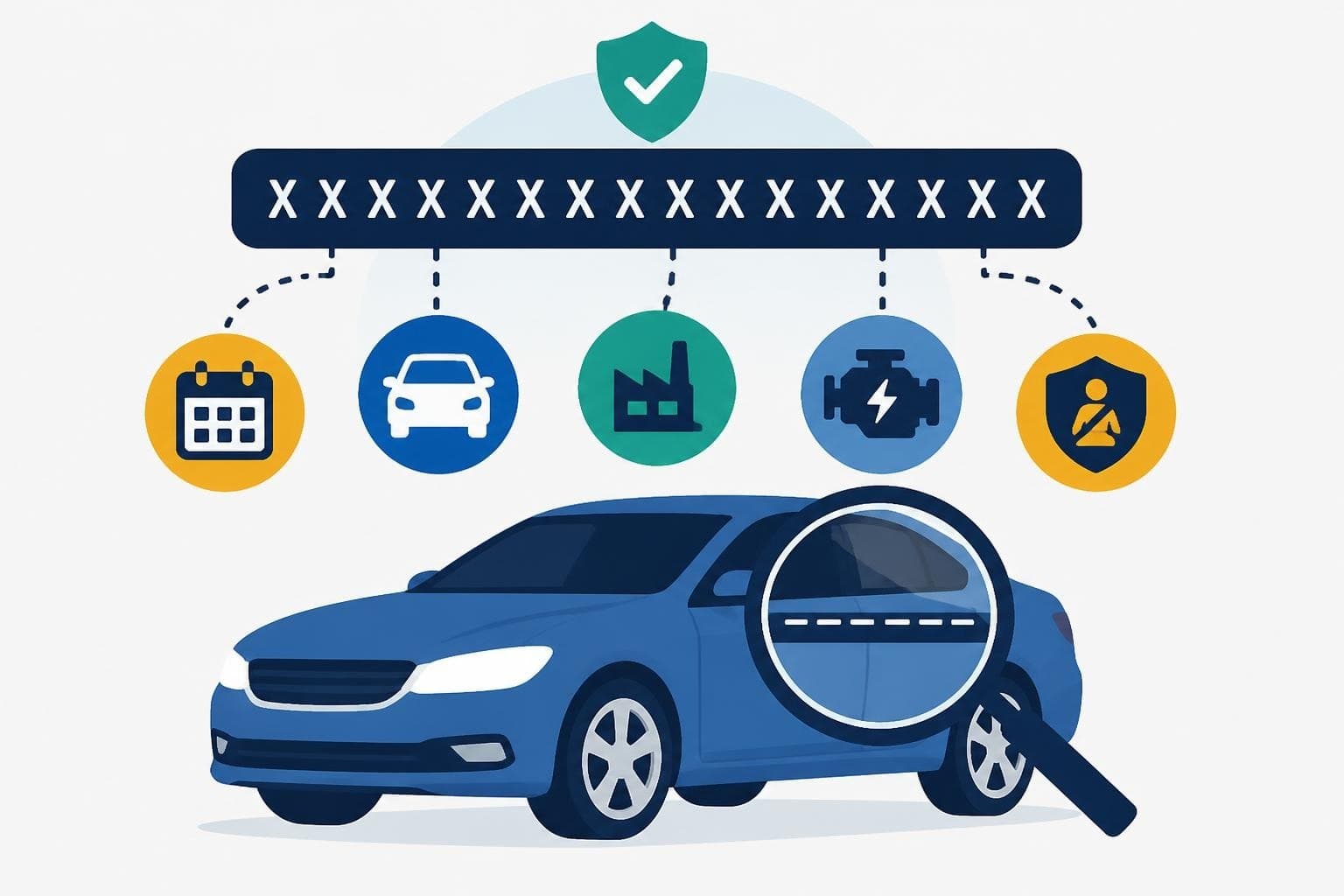
Every vehicle sold in the United States and Canada since 1981 carries a unique 17-character code that tells its complete story. That code is the Vehicle Identification Number, or VIN, and it's the most reliable way to identify a specific car. Whether you're buying a used Honda Civic or researching a classic Ford Mustang, car identification by VIN gives you precision that make and model alone can't provide. This guide walks you through everything you need to know about VINs, how to decode them, where to find them, and why they matter when you're shopping for a used vehicle.
What is a VIN and why does it matter
The VIN is essentially a vehicle's fingerprint. No two cars share the same VIN, which makes it the definitive identifier for any automobile. This standardized format replaced the chaotic pre-1981 system where manufacturers used their own numbering schemes, often with fewer than 17 characters.
The standardization came through federal regulations, specifically 49 CFR Part 565, which requires manufacturers to assign VINs according to strict rules. The law spells out what information must be encoded and how.
Car identification by VIN matters for several practical reasons:
- It distinguishes between two identical-looking cars with different equipment packages
- It reveals if a vehicle has been recalled for safety defects
- It uncovers the true history of accidents, damage, and title problems
- It confirms whether the car in front of you matches the paperwork
- It prevents fraud like VIN cloning, where criminals copy a clean VIN onto a stolen car
When you're looking at a used car, the VIN gives you certainty. The seller might say it's a 2018 model with low mileage and no accidents, but the VIN doesn't lie.
How to decode the 17 characters
Each position in a VIN carries specific information. Understanding this structure helps you verify basic facts about a vehicle before you even request a history report.
Positions 1-3: World Manufacturer Identifier (WMI)
The first three characters identify the country of origin and the manufacturer. Position one is the country: 1, 4, or 5 means United States; 2 means Canada; 3 means Mexico; J means Japan; K means South Korea; W means Germany.
Positions two and three narrow it down to the specific manufacturer. For example, 1G1 is Chevrolet (US), 1FA is Ford (US), JM1 is Mazda (Japan), and WBA is BMW (Germany).
Positions 4-8: Vehicle descriptor section
These five characters describe the vehicle's attributes: model line, body style, engine type, and sometimes restraint systems. Each manufacturer uses its own coding system here, so a "C" in position four might mean one thing for Toyota and something completely different for Honda.
Position eight often indicates the engine. In many Ford VINs, for instance, different letters represent different engine sizes and types.
Position 9: Check digit
The ninth character is a calculated value (0-9 or X) that validates the entire VIN. It's generated through a complex mathematical formula that takes into account all the other characters. If someone transposes two digits when writing down a VIN, the check digit usually catches that error. You can verify a VIN's validity using a free VIN validator before paying for any report.
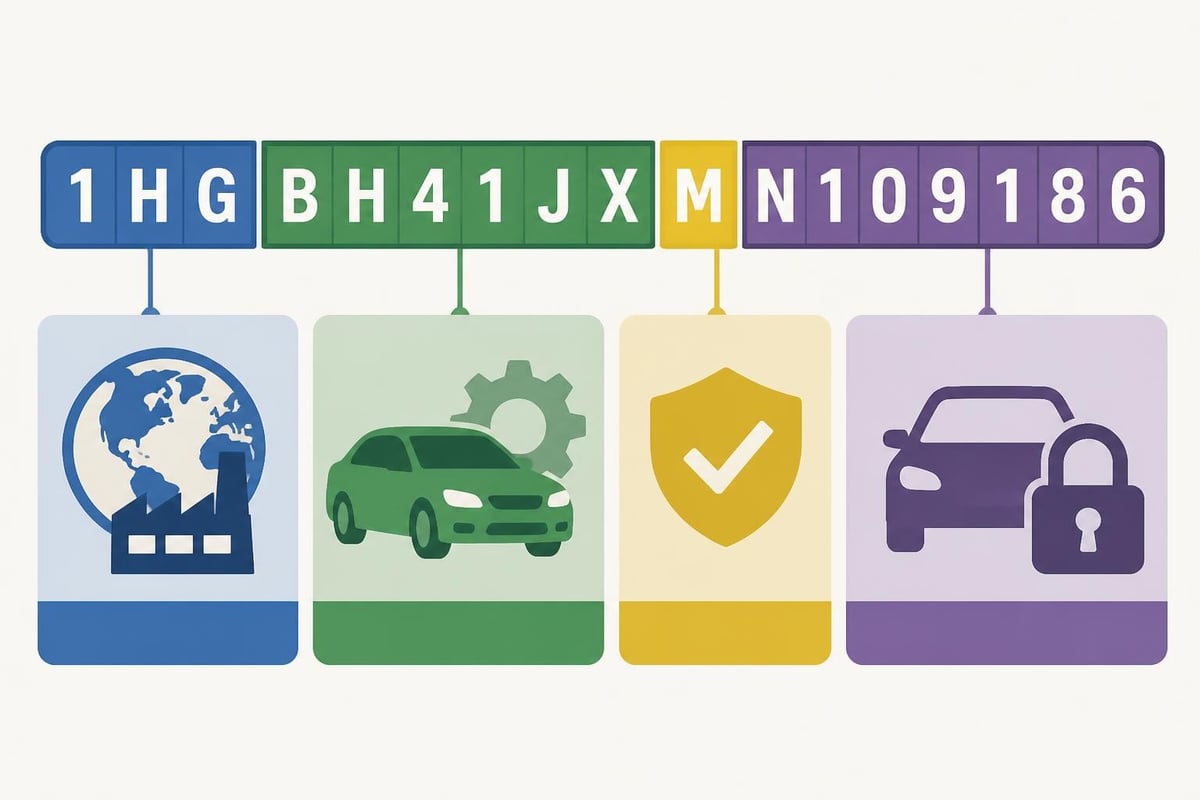
Position 10: Model year
This character tells you the model year, not the calendar year it was built. Cars are often manufactured in the year before their model year (a 2026 model might roll off the line in late 2025).
The code cycles through letters and numbers: A=1980, B=1981, and so on, skipping I, O, Q, U, and Z to avoid confusion. Y=2000, 1=2001, 2=2002, continuing to 9=2009, then A=2010. For 2026, the code is R.
Position 11: Assembly plant
This single character identifies which factory assembled the vehicle. Manufacturers with multiple plants use different codes for each location.
Positions 12-17: Serial number
The last six characters are the vehicle's unique serial number within that manufacturer's production run. These are typically numeric, though some manufacturers use letters.
Where to find a vehicle's VIN
You'll need the VIN in several situations: buying a car, getting insurance, checking for recalls, or pulling a history report. Knowing where to look saves time and helps you spot red flags.
Common VIN locations include:
Dashboard (driver's side) - Look through the windshield at the base of the dashboard on the driver's side. This is the easiest spot to check without opening anything.
Driver's door jamb - Open the driver's door and look at the pillar where the door latches. There's usually a sticker with the VIN, along with tire pressure and other specs.
Engine block - Some vehicles have the VIN stamped on the engine itself. This is harder to find but useful for verifying the engine hasn't been swapped.
Title and registration - These documents always list the VIN. Compare the paperwork to the physical VIN on the car. If they don't match, walk away.
Insurance card - Your insurance documents include the VIN for the covered vehicle.
When you're looking at a used car, check multiple VIN locations. If the dashboard VIN doesn't match the door jamb VIN, that's a major warning sign of tampering or VIN cloning. Criminals sometimes replace VIN plates to hide a vehicle's true identity.
Using car identification by VIN for vehicle history
The VIN unlocks a vehicle's complete documented history. This is where car identification by VIN becomes most valuable for used car buyers.
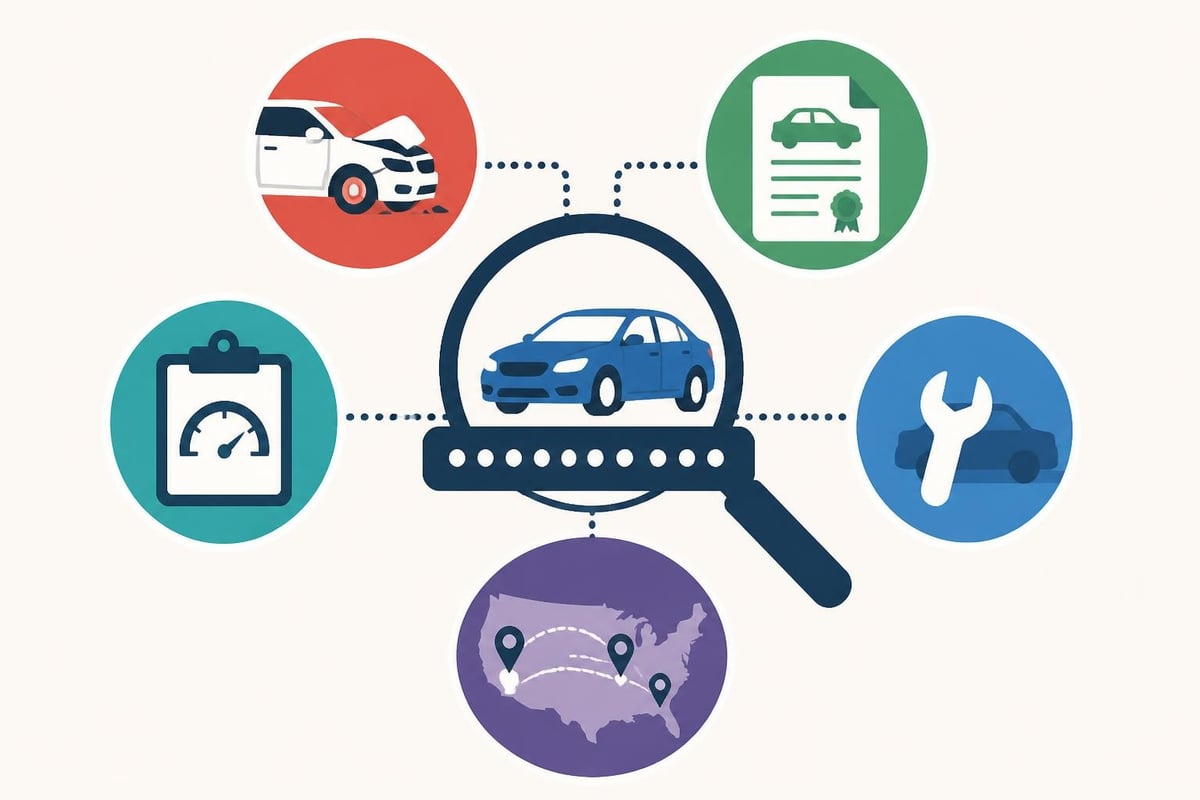
A comprehensive vehicle history report pulls together records from:
- State DMVs (title records, odometer readings, registration history)
- Insurance companies (accident claims and total loss reports)
- Auto auctions (wholesale transactions and condition reports)
- Service facilities (maintenance records and reported problems)
- Collision repair shops (damage repairs and parts replaced)
- Police reports (theft recovery and incident reports)
The federal government maintains the National Motor Vehicle Title Information System (NMVTIS), which aggregates title and brand data from participating states. According to NMVTIS documentation, this database helps prevent fraud by tracking title washing and odometer rollback across state lines.
What a VIN-based history report reveals
Information Category What You Learn Why It Matters Accident history Number and severity of reported accidents Structural damage affects safety and value Title brands Salvage, flood, rebuilt, lemon law buyback Legal and insurance complications Odometer readings Mileage at registration, inspection, service Catches odometer rollback fraud Ownership history Number of previous owners, personal vs commercial use Indicates how the car was used and maintained Service records Oil changes, repairs, recalls addressed Shows maintenance qualityFor a detailed look at what's included, check out a sample report before you buy.
Free vs paid VIN lookups
You'll find both free and paid options for car identification by VIN. Each serves a different purpose.
Free VIN tools
The NHTSA's vPIC database decodes basic vehicle specifications from the VIN at no cost. You'll get year, make, model, body style, engine type, and manufacturing details. A free VIN decoder gives you this same information instantly, which helps verify that the car matches its listing.
Free recall lookups, like our recall check, search NHTSA's database for open safety recalls. Since manufacturers must fix recall issues at no charge, this is worth checking before and after you buy.
What free tools won't tell you:
- Whether the car has been in accidents
- If it has a salvage or flood title
- The actual odometer history over time
- How many owners it's had
- Where and how it was used
Paid vehicle history reports
Full history reports cost money because they pull from private databases that companies have built over decades. Insurance claims, auction records, and service shop data aren't public information. Someone had to negotiate access to those sources, then build systems to search them by VIN.
Carfax is the most recognized brand in vehicle history reports, but pricing varies widely depending on where you buy. For current rates, see our pricing page.
The key is getting the same Carfax data at a fair price. Reports usually arrive in about a minute, and if a report can't be produced for a VIN, you get your credit back automatically.
Common VIN-related fraud schemes
Understanding how criminals manipulate VINs helps you protect yourself when buying a used car.
VIN cloning
This is the most common VIN fraud. A thief finds a legally registered vehicle that matches a stolen car in year, make, and model. They copy that legitimate VIN and create fake VIN plates and documents for the stolen vehicle. The cloned car appears clean in database searches because the VIN actually belongs to a real, uncompromised vehicle somewhere else.
Red flags for VIN cloning:
- VIN plates look freshly attached or poorly secured
- VIN on the dashboard doesn't match the door jamb VIN
- VIN fonts or stamping look inconsistent between locations
- Title or registration seems recently issued for an older car
- Seller can't provide comprehensive service history
Researchers studying automotive forensics have documented VIN tampering techniques and how investigators detect them through microscopic examination and metallurgical analysis.
VIN etching scams
Dealers sometimes push VIN etching as an expensive add-on ($200-$400). They claim it deters theft because the VIN etched on windows makes the car harder to resell. In reality, VIN etching kits cost about $25 and take ten minutes to apply. It's not worthless, but it shouldn't cost hundreds of dollars.
Title washing
Criminals move a salvage or flood-damaged vehicle between states to "wash" the title brand. Some states have weaker reporting systems, creating opportunities to re-title a vehicle without carrying forward its damage history. Car identification by VIN helps catch this fraud because multi-state databases track title records across jurisdictions.
VIN standards in other countries
The 17-character VIN format is used globally, but regulations vary by region.
European vehicles follow similar VIN structures under EU type-approval regulations. The European Commission's vehicle identification guidance outlines how VINs must be assigned and displayed on vehicles sold in EU member states.
Imported vehicles sometimes create confusion. A car manufactured in Germany for European sale has a VIN, but if it was never intended for the US market, it might not have a complete history in American databases. The VIN decoder will work, but a history report might return limited information.
Canada uses the same VIN system as the United States. Cars sold in both countries generate records in shared databases, making cross-border vehicle history checks reliable.
Practical steps for using VINs when car shopping
Here's how to put car identification by VIN to work during your next used car purchase.
Before you even see the car:
- Ask the seller for the VIN over email or text
- Run the VIN through a free decoder to confirm basic specs
- Check for open recalls using a free recall tool
- Pull a complete vehicle history report to review accidents, titles, and ownership
If the seller refuses to provide the VIN in advance, that's a red flag. Legitimate sellers have nothing to hide.
When you inspect the car in person:
- Verify the VIN on the dashboard matches what the seller provided
- Check the door jamb VIN and any other accessible VIN locations
- Compare the VINs to the title and registration documents
- Look for signs of tampering: mismatched rivets, fresh adhesive, inconsistent fonts
Bring a flashlight and don't be shy about looking closely. A seller who gets defensive about you checking VINs is probably hiding something.
Common mistakes to avoid:
- Writing down the VIN wrong (the check digit catches some errors but not all)
- Assuming an accident-free Carfax means no accidents (it means no reported accidents)
- Ignoring multiple VIN locations (checking just one isn't enough)
- Skipping the history report to save money (false economy when buying a used car)
Industry tools and technical standards
Professionals in automotive sales, insurance, and law enforcement use specialized VIN tools beyond what consumers typically access.
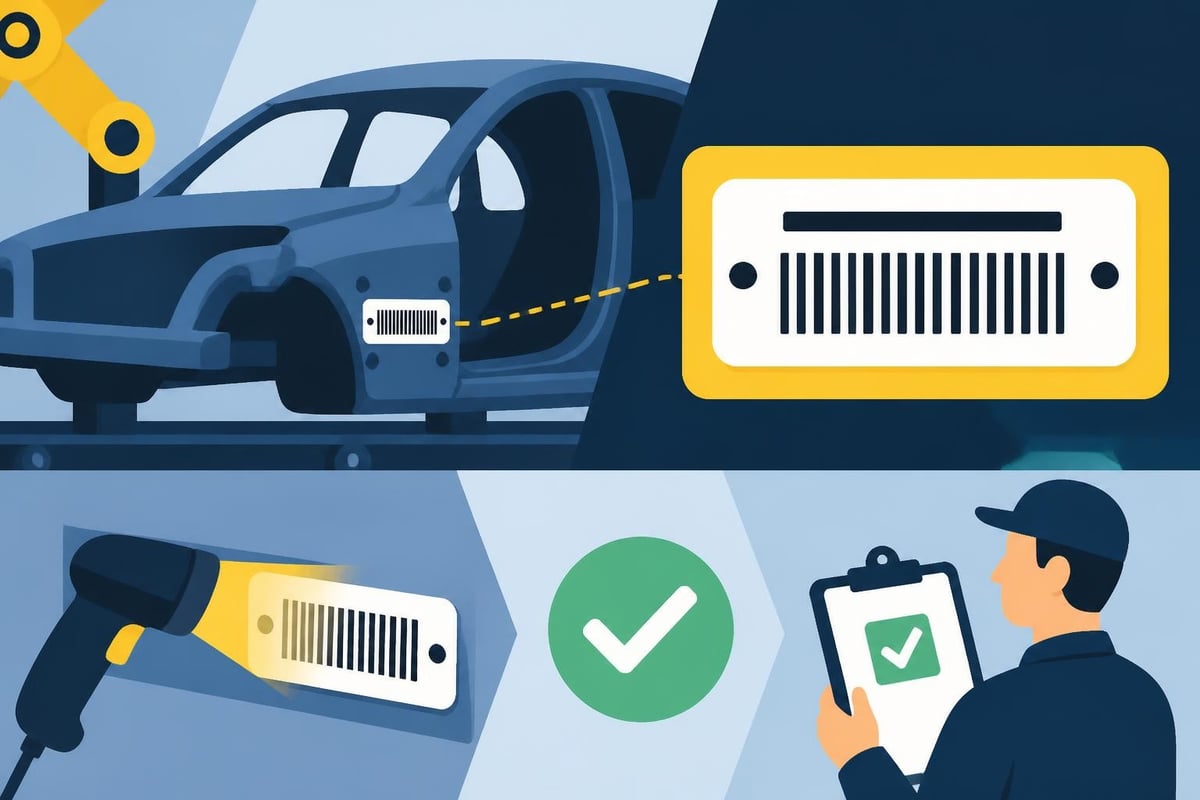
VIN barcode labels, standardized under SAE J1877, allow automated scanning during manufacturing, inspection, and registration. These barcodes encode the full VIN in machine-readable format, reducing data entry errors.
Auto dealerships use integrated systems that pull service histories, recall campaigns, and warranty information instantly from a VIN lookup. These professional tools cost thousands of dollars annually in subscription fees.
Police departments access the National Crime Information Center (NCIC) database, which flags stolen vehicles by VIN. This isn't available to the public, but it's why you should never buy a car without verifying the seller's identity and ownership documents.
How accurate is VIN-based identification
Car identification by VIN is highly accurate for its intended purpose: identifying the vehicle as it left the factory. The VIN tells you what the manufacturer built, not necessarily what sits in front of you today.
VINs accurately reveal:
- Original year, make, model, and trim
- Factory-installed engine and transmission
- Manufacturing location and date
- Original equipment and options
VINs don't capture:
- Modifications made after sale (engine swaps, aftermarket parts)
- Unreported accidents or damage
- Off-the-books repairs
- Current mechanical condition
This is why a VIN check is just one part of buying a used car. You also need a thorough pre-purchase inspection from a mechanic you trust.
Record keeping and VIN documentation
Keep your vehicle's VIN handy throughout ownership. You'll need it repeatedly for insurance quotes, registration renewal, recall checks, and eventually resale.
Smart places to record your VIN:
- Phone contacts (create a contact for your vehicle with the VIN in the notes)
- Password manager (secure and accessible from anywhere)
- Household documents folder (along with title and insurance papers)
- Cloud storage (photo of the dashboard VIN and door jamb sticker)
When you sell the car, provide the VIN to potential buyers proactively. It signals transparency and speeds up their research process. Buyers who can verify the history before making an appointment are more serious and less likely to waste your time.
Car identification by VIN gives you power as a used car buyer. The 17-character code unlocks detailed information about any vehicle's history, specifications, and potential problems. Between free decoders, recall checks, and comprehensive history reports, you can research a car thoroughly before spending a dollar. When you're ready to check a vehicle's complete history, Carfax Vin Check delivers full Carfax reports for US and Canadian vehicles at prices that make sense for private buyers and dealers alike.
Check the car before you buy it
The full Carfax report for $7.99, or $3.50 each in a 20-pack.