Buying Guides4 min read
Carfax report or pre-purchase inspection? Why you want both
By Carfax Vin Check team
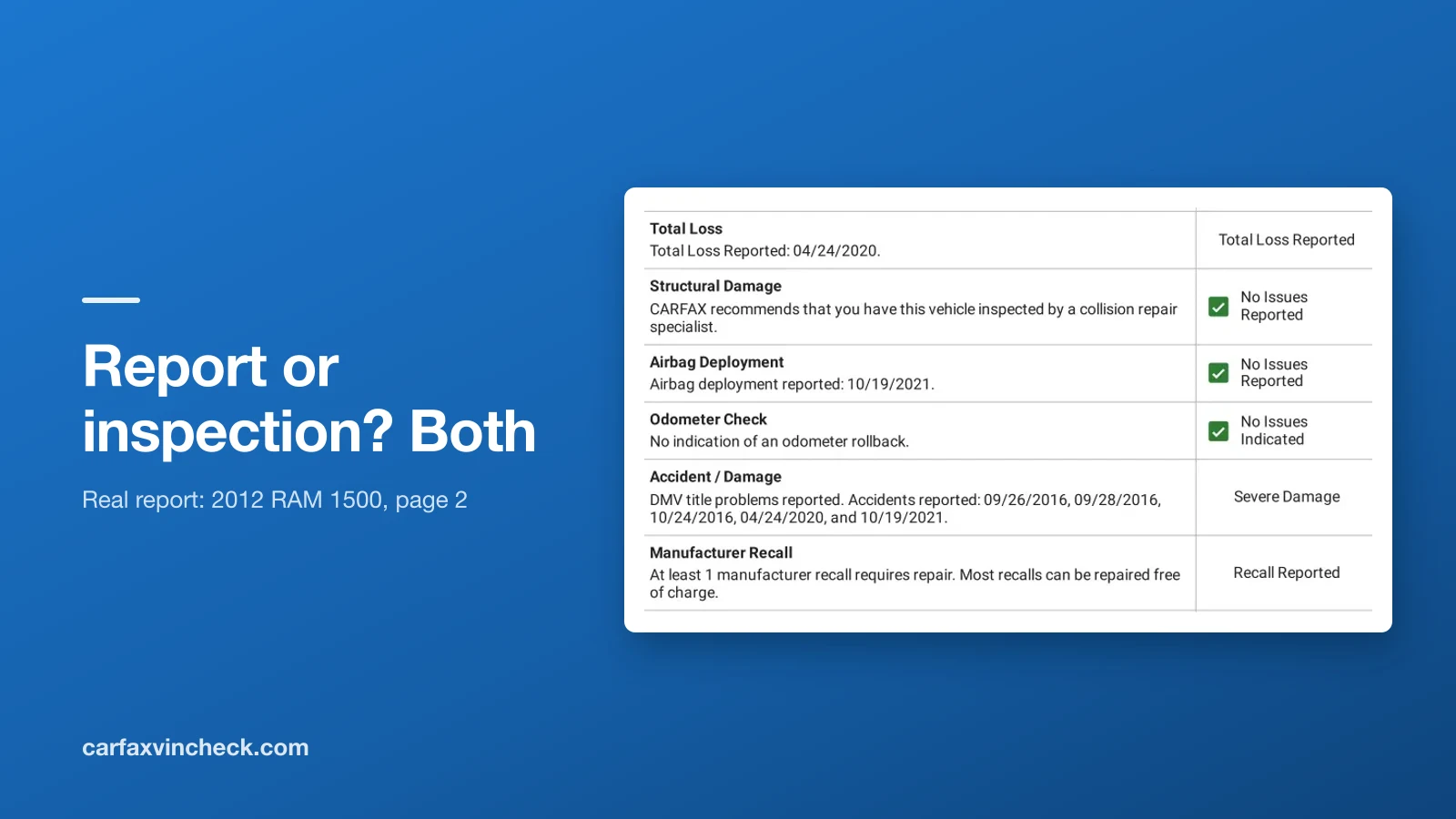
You want both, in that order. A Carfax report tells you what was recorded about a car: accidents, title brands, mileage, owners and service. A pre-purchase inspection tells you what condition the car is in today, including problems nobody ever reported. The report is cheap and quick, so use it to rule cars out. Then pay a mechanic to inspect the one you're about to buy, and give them the report so they know where to look.
Report vs inspection at a glance
- A report covers the past: accidents, total losses, title brands, odometer readings, owners, services, and open recalls.
- An inspection covers the present: mechanical condition, hidden damage, leaks, worn parts, fault codes.
- A report misses damage that was never reported.
- An inspection misses things only paperwork shows, like a salvage title or a rolled-back odometer with no physical sign.
- When to use each: a report on every serious candidate, an inspection on the car you're about to buy.
What a Carfax report catches that an inspection can't
A mechanic can see a repaired panel, but not that the car was declared a total loss, branded salvage, then rebuilt. They can read the odometer, but not the readings recorded over the years. They can't see a lien, how many owners there were, or that the car was a rental.
Our sample report, a 2012 RAM 1500, is a good example. A clean, freshly repaired truck could look fine on a lift. The report shows six accidents, a 2020 total loss, a salvage title and then a rebuilt title, and an open recall.
What an inspection catches that a report can't
Plenty of damage never reaches a database: a crash paid for in cash, a flood with no claim, worn brakes, a leaking head gasket, a transmission that slips when it's warm. Reports also say nothing about wear. Only someone looking at the car can tell you what it will cost you over the next year.
Reports are honest about this. The sample report's additional-history table, next to "Structural Damage", says Carfax recommends having the vehicle inspected by a collision repair specialist.
How to use both, step by step
- Shortlist cars from listings, and get the VIN for each one you're serious about.
- Run a Carfax report on each. Drop any with title brands, rollback signs or a pattern of accidents you don't want to deal with.
- Check open recalls on the finalists with our free recall check or NHTSA's recall lookup.
- Agree a price in principle with the seller, subject to inspection.
- Book an independent mechanic you choose, not one the seller picks.
- Give the mechanic the report. Point out the areas on the damage diagrams, any total loss, and any gaps in the service history.
- Ask for a scan of fault codes, a check of the frame and suspension, a look under the car for leaks and rust, and a test drive on different roads.
- Use the findings to negotiate, or to walk away.
Warning signs during this process
- The seller refuses an independent inspection, or insists on their own mechanic.
- The car's history doesn't match the seller's story about it.
- The report shows a total loss the seller didn't mention.
- The inspection finds repaired damage where the report shows nothing, which means an unreported accident.
Questions about reports and inspections
Is a Carfax report enough to buy a used car?
No. It tells you the recorded history, not the car's current condition. Pair it with an inspection by a mechanic you choose.
Is a pre-purchase inspection enough without a report?
Not really. A mechanic can't see title brands, total losses, liens, owner history or past mileage readings. Those come from records.
Which should I do first?
The report. It's quicker and cheaper, it rules out bad cars before you spend on inspections, and it tells the mechanic where to look.
What if the seller won't allow an inspection?
Treat it as a reason to walk away. A seller with nothing to hide usually agrees.
Start with the history. Enter the VIN for the full Carfax report, $7.99 for one or $3.50 a report in the 20-pack.
Check the car before you buy it
The full Carfax report for $7.99, or $3.50 each in a 20-pack.