Vehicle History2 min read
What "damage reported" means on a Carfax report
By Carfax Vin Check team
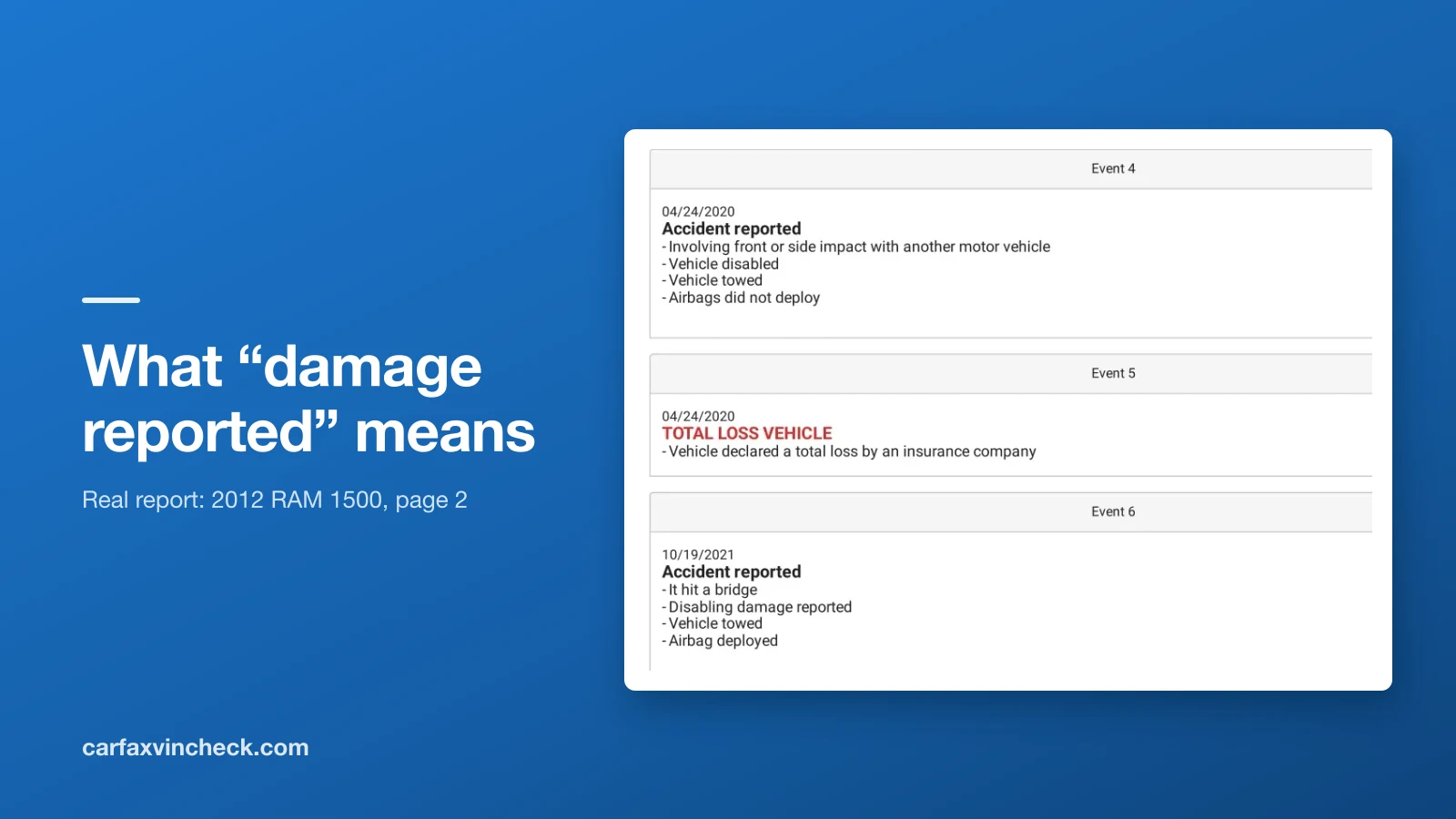
"Damage reported" is the line that makes most buyers stop scrolling. It sounds serious, and sometimes it is. Often it's a scraped bumper that was fixed years ago. The entry on its own doesn't tell you which, so the useful skill is reading what sits around it.
Where the entry comes from
Carfax doesn't inspect cars. It collects records from other places: police accident reports, insurance claims, collision repair shops, auctions, and state title agencies. When one of those sources says the car was damaged, the report gets an entry with the date, the location, and whatever detail the source gave.
That has two consequences. A damage entry means someone with paperwork saw damage. And no entry doesn't mean no damage: a crash repaired for cash at a small shop, with no claim and no police report, can leave no record anywhere.
What to look at in the entry
- Severity. When the source gives it, the report says how bad the damage was. A minor entry is a different conversation from a severe one.
- Where the car was hit. Many entries come with a damage diagram that marks the area, such as the front left corner or the rear. We explain those in our damage diagram guide.
- Airbag deployment. An airbag going off usually means a real impact, and airbags have to be replaced properly after it.
- What happened next. A total loss, a salvage title or a rebuilt title after a damage entry changes the car's value far more than the damage itself.
- How many times. One minor entry in ten years is common. Several entries on the same car is a pattern.
A real example
Our sample report, a 2012 RAM 1500, shows how quickly this adds up. It lists six accidents. The first ones come with damage diagrams on page 4. On page 2 there's a 2020 total loss and a 2021 bridge strike that set off an airbag. By the end the truck carries salvage and rebuilt title brands. Any single entry might be survivable. Together they describe a truck you'd want a very low price and a thorough inspection for.
Questions to ask the seller
- Who repaired it, and do you have the invoice?
- Was it an insurance claim? If so, what did the insurer pay?
- Were any airbags or structural parts replaced?
- Can I take it to a mechanic of my choice before I buy?
A seller who has repair paperwork and agrees to an inspection makes a damage entry much less worrying. A seller who gets vague about it is telling you something too.
Should you walk away?
Not automatically. A well-repaired minor accident can be a fair reason to pay less for a good car. Walk away, or pay a lot less, when you see structural damage, an airbag deployment with no repair records, a total loss, or several accidents. In every case, have a mechanic look at the car before money changes hands. A report tells you what was recorded. An inspection tells you what's there now.
Want to see the damage history for a specific car? Enter the VIN to get the full Carfax report for $7.99, or $3.50 a report in the 20-pack.
Check the car before you buy it
The full Carfax report for $7.99, or $3.50 each in a 20-pack.