Vehicle History2 min read
The Carfax damage diagram, explained with a real example
By Carfax Vin Check team
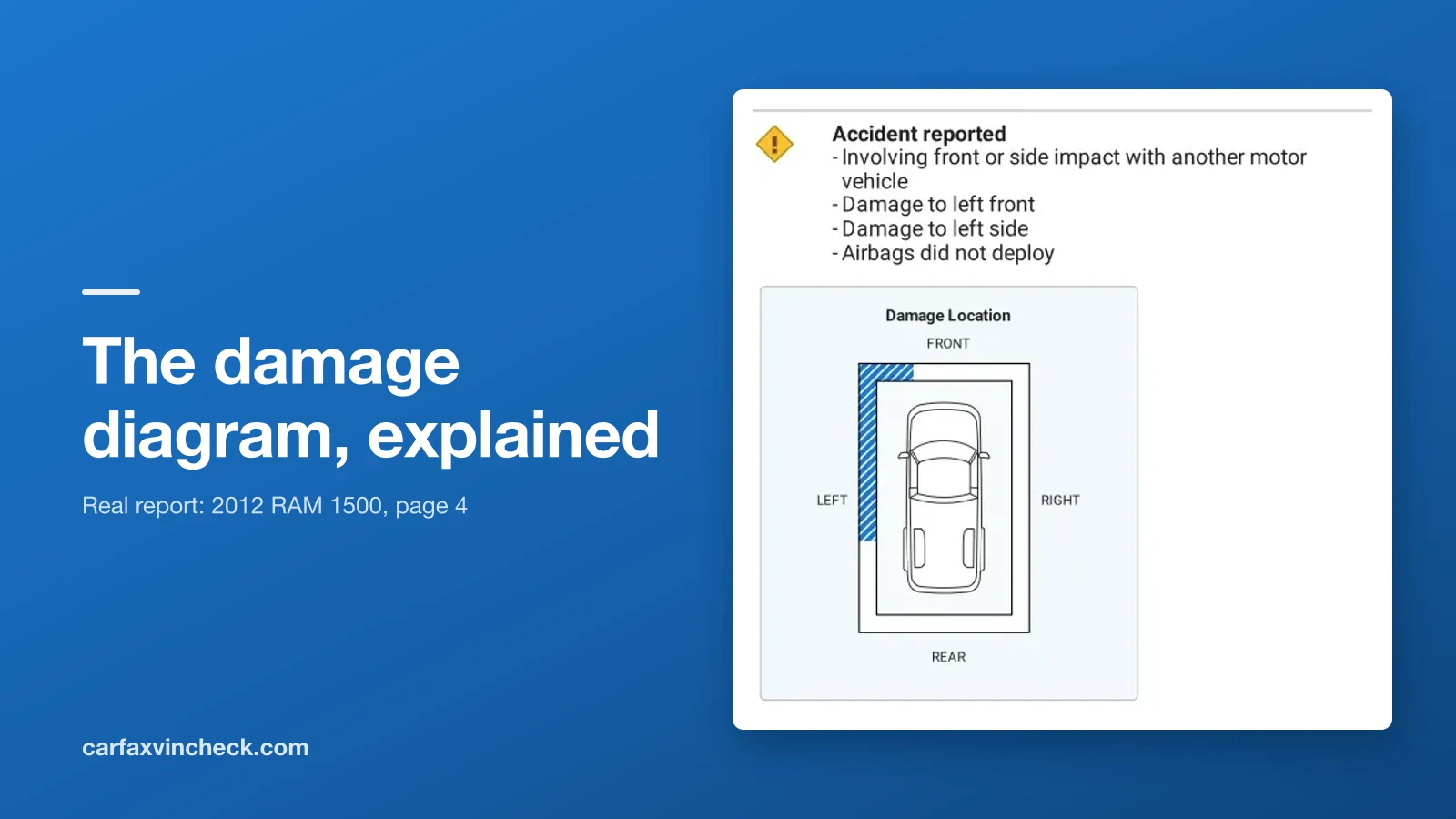
Next to many accident entries on a Carfax report sits a small outline of a car with part of it marked. That's the damage diagram. It answers one question well, where the car was hit, and people often read more into it than it holds.
What the diagram shows
The diagram marks the area of the car that the reporting source said was damaged: the front, the rear, one side, or a corner. It comes from the same record as the accident entry, usually an insurance claim, a police report or a repair shop.
Use it to plan your inspection. If the diagram marks the front right corner, that's where you look closely: panel gaps, paint that doesn't quite match, overspray on rubber seals, a headlight that looks newer than the other one.
What it doesn't show
- How bad it was. A marked area could be a dent or a crushed corner. Read the severity in the entry itself, if the source gave one.
- Hidden damage. An impact at the front can bend parts behind the bumper that no drawing shows. The diagram marks the point of impact, not everything that moved.
- The repair. It says nothing about whether the car was fixed, or how well.
A real example
Our sample report is a 2012 RAM 1500 with six accidents. The diagrams for its 2016 accidents are on page 4. Read them alongside the entries and the later history: this truck went on to a 2020 total loss and a salvage title, then a rebuilt title after repairs (page 6). The early diagrams show where it was hit. The title history shows how the story ended.
How to use a diagram when you see the car
- Note every marked area across all the accident entries.
- Walk around the car and compare those areas with the opposite side. Repaired panels often differ in shine, texture or gap width.
- Ask for repair invoices for those areas specifically.
- Tell your mechanic where the diagrams point, so the inspection starts there.
When there's no diagram
Not every entry has one. Some sources don't record where the car was hit. A missing diagram isn't good or bad news. It just means you lean on the entry text, the seller's records and the inspection instead.
See the diagrams for a car you're looking at. Enter the VIN for the full Carfax report, $7.99 for one or $3.50 a report in the 20-pack.
Check the car before you buy it
The full Carfax report for $7.99, or $3.50 each in a 20-pack.